Min-jun: The Complete Guide to Meaning, Origin, and Trends
Choosing the right name for a child is easily one of the most exciting-and overwhelming-parts of early parenthood. You want something that sounds great when spoken aloud, carries a deep personal significance, and stands the test of time. If you have been looking into modern global names with deep roots, you have almost certainly come across this classic choice.
Min-jun has dominated baby name charts in South Korea for over two decades. It balances strength, intelligence, and modern style effortlessly. But what makes this two-syllable name so enduringly popular, and why is it finding a warm reception among parents around the world?
Let’s look at the true origins, rich cultural history, and linguistic details behind one of the most iconic contemporary Korean names for boys.
Understanding the Meaning and Roots of Min-jun
To really appreciate the depth of this name, you have to look at how Korean names are built. Most Korean given names are composed of two distinct Sino-Korean syllables, each derived from traditional Chinese characters known as Hanja. Because multiple Hanja characters can share the exact same pronunciation, a single name can hold several beautiful meanings depending on the specific characters chosen by the parents.
The first syllable, Min, is most frequently written with the Hanja character meaning “clever,” “quick-witted,” “smart,” or “gentle.” It conveys intellectual agility and a thoughtful disposition. Parents who choose this syllable often hope their child will navigate life with wisdom, sharp perception, and kindness toward others.
The second syllable, Jun (often spelled Joon in English transliterations), commonly uses Hanja characters representing “talented,” “handsome,” “exceptionally gifted,” or “outspoken.” When you put these two concepts together, the overarching character profile becomes remarkably clear and inspiring.
Truth is, the combination creates a harmonious balance. It unites mental sharpness with physical elegance and personal talent. Rather than focusing solely on raw power or passive grace, the name offers a rounded ideal of human excellence that resonates deeply across cultures.
Why Min-jun Remained a Top Choice for Decades
In South Korea, name trends often shift alongside cultural waves, television dramas, and celebrity influences. Yet, very few names manage to hold the top spot on national birth registries for more than a couple of years. This name is a remarkable exception to that rule.
Throughout the 2000s and 2010s, it routinely claimed the number one position for newborn boys across South Korea. It consistently ranked alongside other beloved choices like Seo-jun, Ha-joon, and Do-yun. But its longevity is truly extraordinary. An entire generation of children grew up sharing this proud title.
| Decade / Era | Popularity Status in South Korea | Key Cultural Factors |
|---|---|---|
| 1990s | Emerging Trend | Shift toward soft yet strong two-syllable masculine names. |
| 2000-2009 | #1 Most Popular Boy Name | Widespread adoption across major metropolitan areas like Seoul. |
| 2010-2019 | Consistently Top 3 | Pop culture prominence in hit Korean television dramas. |
| 2020-Present | Modern Classic | Maintains strong usage while expanding internationally. |
So, why did it stay on top for so long? Here’s the deal. It sits right in the golden sweet spot of phonetics. It is short, energetic, and rhythmic. It carries soft consonant sounds that feel approachable, yet ends on a clean, decisive nasal tone that gives it structure and weight.
Furthermore, Korean pop culture played an undeniable role in cementing its global prestige. When the hit television series My Love from the Star premiered in 2013, millions of viewers worldwide fell in love with the lead character, Do Min-jun, played by actor Kim Soo-hyun. That single show introduced the name to international audiences from Los Angeles to Manila, transforming it from a national favorite into a globally recognized handle.
How To Pronounce and Spell the Name Correctly
For parents raising children in Western countries, usability and pronunciation are always top priorities. You want a name that honors cultural heritage without forcing your child to correct teachers and colleagues for the rest of their life.
Luckily, this name translates seamlessly into English-speaking environments. The pronunciation is simple, predictable, and clean once you understand the basic phonetic components:
- First Syllable (Min): Pronounced exactly like the English word “min” in minimum or mint.
- Second Syllable (Jun): Pronounced like “joon” or “june,” matching the vowel sound in moon or june.
- Full Phonetics: MIN-joon (with equal stress on both syllables, or a very light emphasis on the first).
When writing the name in English script, you will see a few common variations. The Revised Romanization system officialized in South Korea uses the hypenated form Min-jun. However, you will frequently see it written without a hyphen as Minjun, or with an alternate spelling as Min-joon or Min joon.
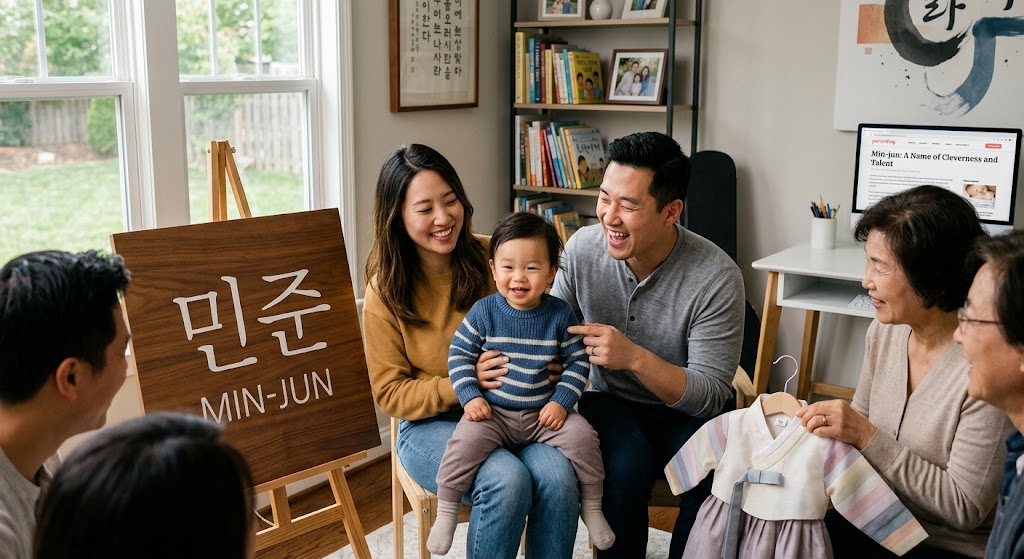
All of these spellings represent the exact same Korean name (민준 in Hangul). Choosing between them is simply a matter of personal visual preference and administrative convenience in your home country.
Key Character Traits and Symbolic Values
In Korean culture, a name is far more than an arbitrary label. It is considered a foundational gift-an wishful blueprint for a child’s character, future success, and health. Traditional naming practices often consult family elders or professional naming masters to analyze Hanja combinations alongside the child’s birth date and time.
Parents selecting this specific combination are traditionally looking to bestow several core virtues onto their son:
- Intellectual Curiosity: A natural drive to learn, think critically, and master complex skills.
- Refined Elegance: Emotional poise, gentle manners, and respectful communication with peers and elders.
- Resourceful Leadership: The ability to guide others through talent and wisdom rather than brute force.
- Inner Strength: Resilience during challenging times, anchored by a clear sense of identity.
To be honest, these values appeal to parents everywhere, regardless of their background. The desire for a child to be both smart and kind, talented yet grounded, is a universal parenting goal.
Comparing Min-jun to Other Popular Korean Boy Names
If you are building a shortlist of Korean male names, it helps to see how different options compare in terms of tone, meaning, and global ease of use. Many modern Korean boy names share the Jun or Min syllables, creating subtle variations in style.
| Name (Hangul) | Primary Hanja Meanings | Phonetic Style in English |
|---|---|---|
| Min-jun (민준) | Clever + Talented / Handsome | Soft, rhythmic, extremely approachable |
| Seo-jun (서준) | Auspicious / Composed + Talented | Sleek, trendy, modern urban feel |
| Do-yun (도윤) | Path / Principle + Allow / Consent | Melodic, gentle, gentle vowel flow |
| Ha-joon (하준) | Great / Summer + Talented | Bright, bold, strong initial breath |
| Min-jae (민재) | Clever + Ability / Talent | Crisp, energetic, sharp ending |
Look at the subtle differences here. While Seo-jun carries a slightly sleeker, ultra-modern vibe and Do-yun leans into a soft, melodic flow, Min-jun stands firm as the timeless middle ground. It feels grounded without sounding dated, and stylish without feeling like a temporary fad.
Cultural Advice for Choosing a Korean Name in the US
If you are an diaspora family, a multicultural couple, or simply someone who admires Korean culture, selecting a traditional given name in a Western setting comes with a few practical considerations. Here are a few tips to ensure a smooth naming process:
- Check Middle Name Harmony: Many parents raising kids in North America pair a Korean given name with a traditional Western middle name (or vice versa) to give their child maximum flexibility in personal and professional life.
- Consider Legal Documentation: Decide early on whether you want to include a hyphen on official government documents like birth certificates and passports. Some digital registration systems in the United States do not support hyphens, turning Min-jun into Minjun automatically.
- Practice Family Pronunciation: Run the name past non-Korean relatives or friends. You will quickly find that almost everyone can pronounce this name correctly on their very first try, which is a massive practical benefit.
- Explore the Hanja Options: If you want to adhere to tradition, spend time researching the specific Hanja characters for your child’s name with family elders or a knowledgeable specialist to ensure the exact personal meaning aligns with your hopes.
By taking these steps early, you ensure that the name serves as a lifelong bridge between cultural heritage and daily practical living.
Frequently Asked Questions About Min-jun
What Does Min-jun Mean?
The name is most commonly translated as “clever and talented” or “smart and handsome.” It is formed by combining the Sino-Korean syllable Min (meaning clever, gentle, or quick-witted) with Jun (meaning talented, handsome, or exceptional).
How Do You Pronounce Min-jun Correctly?
It is pronounced as MIN-joon. The first syllable sounds like the English word “min” in minimum, and the second syllable rhymes with “moon” or “june.”
Is Min-jun a Male or Female Name?
It is almost exclusively used as a masculine given name in South Korea and among overseas Korean communities.
How Is Min-jun Written in Korean Characters?
In the Korean alphabet (Hangul), the name is written as 민준. When written in official Chinese characters (Hanja), various combinations can be used depending on the specific meaning selected by the family.
Is Min-jun Still Popular in Korea Today?
Yes, while it peaked as the number one overall boy name during the 2000s and 2010s, it remains a beloved modern classic that consistently places high on Korean naming registries.
Can Non-Korean Families Choose This Name?
Yes. Many multicultural families and parents living abroad choose the name due to its pleasant sound, noble meanings, and easy pronunciation across different languages.
Should Min-jun Be Written With a Hyphen?
Using a hyphen (Min-jun) is standard under South Korea’s official Revised Romanization system, but writing it as a single word (Minjun) or two words (Min Joon) is also widely accepted and legally valid in most countries.
Final Thoughts on Choosing This Standout Name
At the end of the day, selecting a name is about finding a combination that speaks to your values and feels right for your family’s journey. Min-jun stands out as a remarkable choice because it effortlessly bridges heritage and modernity.
It carries an uplifting set of meanings centered around intellect, character, and talent. It sounds crisp and welcoming in any language, and it holds a storied place in modern cultural history. Whether you are honoring your roots or looking for a name with true international appeal, this timeless choice offers everything you could ask for.
Leave a Reply